2025 Gallery and Museum Achievement Awards
Sustainable Practices
Winner
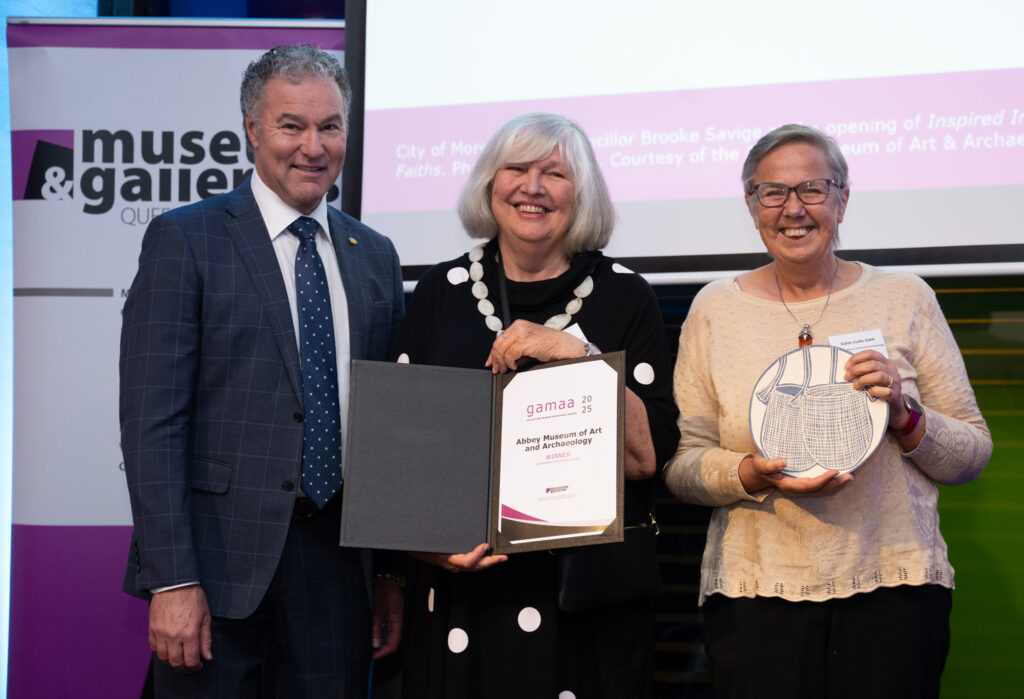
Abbey Museum of Art & Archaeology
Abbey Museum Art Gallery & Café Extension Project
This project saw the Abbey Museum complete its building extension, comprising a new Art Gallery, Reception Area, Café and Shop, delivering much-needed exhibition space, inclusive access and enhanced amenities for visitors.
Standing at the entrance of the building is Acknowledgement to Kabi Kabi Country by Kabi Kabi traditional custodian and artist, Lyndon Davis. This specially commissioned sculpture was unveiled on 28 February 2025, honouring First Nations heritage and the traditional lands upon which the Museum stands. Over 1,800 school students have started their museum visit at the Acknowledgement to Kabi Kabi Country sculpture, increasing awareness and respect for First Nations culture and custodianship of Country.
The inaugural exhibition, Inspired Images: The Art of Faiths, opened by Hon Andrew Powell MP, showcases the Museum’s internationally significant collection. Here, Renaissance and Baroque art are thoughtfully displayed alongside Aboriginal spirit figures and other sacred works from diverse cultures and faiths, curated to foster intercultural understanding. Audiovisuals and interactives are integrated in the exhibition to deepen audience engagement.
Finalist

The University of Queensland Art Museum
Sun Stadium: Public Artwork at UQ St Lucia Campus
Commissioned by The University of Queensland Art Museum on behalf of UQ Arts, Sun Stadium is an innovative public artwork by Bundjalung/Ngāpuhi artist and choreographer Amrita Hepi in collaboration with poet Jazz Money, Dialogue Office’s Christopher Bassi, Five Mile Radius, and Sibling Architecture. It is recognised as a Finalist for its visionary integration of sustainability, cultural storytelling, and public engagement.
Sun Stadium is located between two lakes at the University of Queensland’s St Lucia campus, and takes the form of a life-sized sundial. Visitors stand at its centre, casting shadows across a palindromic poem that encircles the dial, connecting body, sun, and Country. The inscribed poetry is designed to weather with time—as words fade, they transition from didactic instruction to community memory, inviting reflection on deep time, and embedding Indigenous knowledge systems into its structure.